
When purchasing insurance, the base policy often feels straightforward
until your agent or online checkout presents a dizzying array of optional
extras. Critical illness cover, personal accident benefits, waiver of premium,
hospital cash—the list of insurance
riders and add-ons can seem endless. Each promises additional
protection, but each also increases your premium.
The insurance industry's approach to add-on insurance mirrors retail tactics you'll
recognise from other purchases. Yet dismissing all riders as unnecessary would
be equally misguided. Some add-ons provide crucial protection for specific
circumstances, filling gaps that standard policies intentionally leave open.
The challenge isn't whether to purchase extra insurance cover universally, but rather
determining which additions align with your genuine needs, life circumstances,
and risk profile. A rider that's essential for one person might be redundant
for another, depending on existing coverage, family situation, occupation, and
financial resources.
This guide cuts through the confusion surrounding insurance riders and add-ons,
helping you evaluate which extras deserve your premium pounds and which you can
confidently skip.
Understanding Insurance Riders and Add-ons


 Before evaluating specific options, clarity about
what these terms mean prevents confusion during purchase discussions.
Before evaluating specific options, clarity about
what these terms mean prevents confusion during purchase discussions.
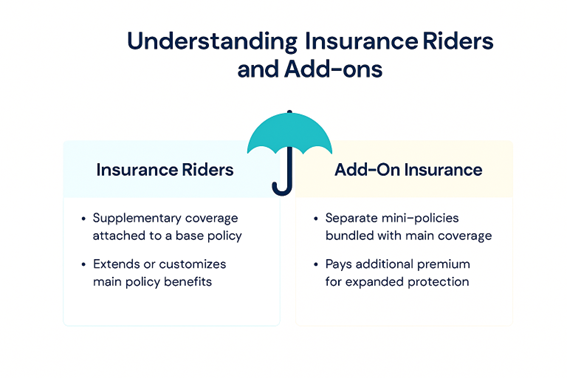
Insurance riders are supplementary
benefits attached to your main policy, extending coverage beyond the base
contract's scope. They function as amendments or additions that customise
standard policies to your specific needs. Riders typically cannot exist
independently—they require an underlying base policy to attach to, much like
extensions require a main building.
Add-on insurance serves a similar
purpose but sometimes operates as separate mini-policies bundled with your main
coverage. The terminology varies between insurers and policy types, but the
principle remains consistent: paying additional premium for coverage beyond
standard policy terms.
The key distinction from standalone policies is integration. Rather
than managing multiple separate insurance contracts, riders consolidate various
protections under one policy umbrella, simplifying administration while often
costing less than equivalent standalone coverage.
The insurance market offers numerous riders, but certain categories
appear consistently across policy types. Understanding these helps frame
decisions about add-on policy
selection.
1.
Health-Related Riders
Critical illness cover pays lump sums upon diagnosis of specified
serious conditions. Hospital cash provides daily allowances during
hospitalisation. Surgical care riders cover operation costs. These address the
financial impact of health events beyond basic policy scope.
2.
Income Protection Extensions
Waiver of premium riders continue coverage without payment during
disability or unemployment. Accident benefits provide payouts for
injury-related disability. These protect your insurance itself when income
disruption threatens your ability to maintain premiums.
3.
Enhanced Benefit Riders
Accelerated benefit options allow early access to death benefits
during terminal illness. Return of premium features refund paid premiums if you
outlive term policies. Increased coverage riders guarantee future coverage
increases without fresh medical underwriting.
4.
Family Protection Add-ons
Spouse and child riders extend coverage to family members under your
policy. Education benefit riders ensure children's school fees continue despite
your death or disability. These address dependant protection comprehensively.
Not all riders provide equal value, and determining which deserve your
money requires systematic assessment rather than emotional reaction to
worst-case scenarios.
1.
Assess Existing Coverage First
Before adding any extra
insurance cover, audit what protection you already possess. Employer
benefits, credit card insurance, mortgage protection, and other existing
policies might duplicate proposed rider coverage. Paying twice for the same
protection wastes money regardless of how valuable that protection might be.
2.
Match Riders to Real Risks
Your personal circumstances determine which risks warrant additional
coverage. Young singles without dependants need different protection than
parents with mortgages and school fees. Evaluate riders against your actual
vulnerabilities rather than generic fear-based marketing.
3.
Consider Probability Versus Impact
Some risks are statistically unlikely but financially catastrophic if
they occur. Others happen frequently but cause manageable disruption. Rider coverage explained
through this lens—weighing likelihood against potential damage—provides clearer
purchase guidance than emotional appeals.
4.
Calculate Cumulative Costs
Individual rider premiums might seem modest, but accumulating multiple
add-ons substantially increases total policy costs. Project these costs across
your policy term to understand the true financial commitment. Sometimes, the
cumulative premium for numerous riders approaches standalone policy costs with
greater flexibility.
5.
Check Exclusions and Conditions
Rider benefits often contain more restrictions than base policies.
Survival periods for critical illness claims, elimination periods for
disability benefits, and specific definitions of qualifying events can limit
practical value. Understanding what's excluded prevents disappointed
expectations during claims.
Image Suggestion:
Title: Which Rider Is
Best: A Framework for Decision-Making
Replaceability Test
Can you afford the loss without insurance? If yes, self-insure. If not,
the rider is essential.
Availability Alternative Test
Is standalone coverage more flexible or affordable?
Life Stage Alignment Test
Does this rider match your current life stage and duration of need?
Opportunity Cost Test
Could the premium be better used for savings, debt, or investments?
 Rather than recommending specific riders
universally, applying decision frameworks helps identify what's appropriate for
your situation.
Rather than recommending specific riders
universally, applying decision frameworks helps identify what's appropriate for
your situation.
The Replaceability Test
Could you financially absorb the loss this rider protects against? If
yes, self-insuring through savings might prove more economical than ongoing
premiums. If no, the rider addresses genuine need rather than theoretical
concerns.
The Availability Alternative Test
Can you purchase equivalent standalone coverage more flexibly or affordably?
Some rider coverage comes at premium pricing compared to dedicated policies,
while other riders offer better value than standalone equivalents.
The Life Stage Alignment Test
Does this protection match your current life stage and likely duration
of need? Coverage for raising children matters during parenting years but
becomes less relevant as children reach independence. Timing your rider
coverage to actual need periods maximises value.
The Opportunity Cost Test
What else could you do with the rider premium? Sometimes redirecting money
toward emergency funds, debt reduction, or investments provides better overall
financial security than additional insurance coverage.
Despite the caution warranted when evaluating extras, certain
circumstances make add-on
policy selection straightforward.
Riders that cannot be added later without medical underwriting deserve
serious consideration at policy inception. Health changes might make future
additions impossible or prohibitively expensive, meaning declining coverage
today eliminates future options entirely. This applies particularly to critical
illness riders and enhanced benefit options tied to health status.
Coverage addressing gaps in standard policies often justifies
additional premium. If base policies explicitly exclude scenarios relevant to
your situation, appropriately targeted riders fill genuine protection holes
rather than duplicating existing coverage.
Bundled discounts sometimes make adding riders economical compared to
standalone alternatives. When insurers offer multiple riders at reduced
combined premiums, the package might deliver better value than cherry-picking
individual coverages separately.
Equally important as knowing when to buy is recognising when to
decline, saving premium for more productive financial purposes.
Overlapping coverage wastes money regardless of how good the
individual protections might be. If existing policies already address the risks
a proposed rider covers, additional layers provide no incremental benefit worth
the cost.
Low-value, high-frequency scenarios often represent poor insurance
targets. Situations you could reasonably handle from savings or routine
budgeting don't warrant insurance premiums that, over time, exceed likely claim
amounts. Insurance works best for high-impact, lower-frequency events.
Marketing-driven rather than need-driven extras deserve scepticism. If
you cannot articulate a specific personal scenario where a rider would prove
essential, you're probably responding to sales pressure rather than genuine
protection requirements.
Evaluating insurance
riders and add-ons ultimately requires balancing comprehensive
protection against budgetary realities and the opportunity cost of premium
expenditure.
Start by identifying your genuine vulnerabilities—the financial
disasters that would devastate your family or derail your life plans. Match
available riders to these specific concerns rather than accumulating coverage
for every theoretical possibility. Prioritise riders addressing your
highest-impact risks within your budget constraints.
Remember that insurance serves to transfer risks you cannot afford to
self-insure. Extra insurance
cover makes sense when it addresses genuine gaps in protection for
scenarios beyond your financial capacity to absorb. It becomes wasteful when it
duplicates existing coverage or insures manageable disruptions better handled
through ordinary budgeting.
The decision whether to pay extra for insurance riders isn't about whether add-ons have
value—many do. It's about whether specific riders address your particular
circumstances sufficiently to justify diverting premium from alternative uses.
By systematically evaluating optional
cover benefits against your real needs, existing protection, and
financial priorities, you transform this complex decision into a manageable
assessment that serves your interests rather than simply generating insurer
revenue.